There’s a quiet shift happening in how organizations deliver projects. Not loud, not branded as the next big framework, but visible in how teams actually work day to day.
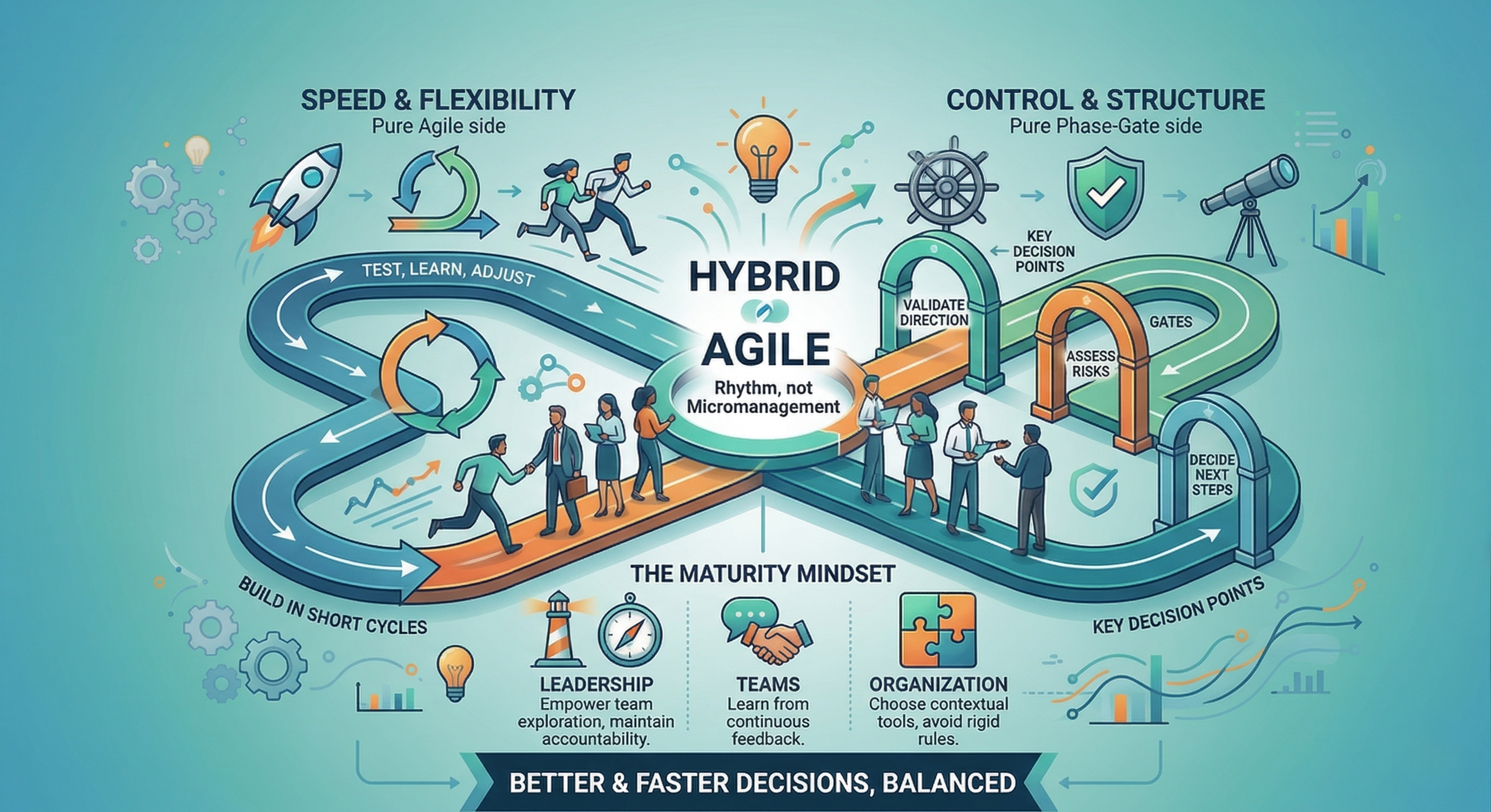
Pure Agile sounds appealing: fast, flexible, adaptive. Pure Phase-Gate promises clarity, control, and structure. In reality, most teams are already somewhere in between, whether they admit it or not.
That “in-between” has a name: Hybrid Agile.
It’s not about forcing two methodologies together. It’s about recognizing that speed without direction creates chaos, and structure without flexibility slows everything down. Hybrid Agile exists because organizations need both.
At its core, this approach allows teams to move iteratively while still respecting key decision points. Work doesn’t stop being Agile; teams still test, learn, and adjust continuously, but there are moments where leadership steps in to validate direction, assess risks, and decide what happens next.
And those moments matter more than people often admit.
Without them, teams can move fast but drift away from strategic goals. With too many of them, momentum disappears. The real challenge isn’t adopting Hybrid Agile, it’s designing it well.
When done right, it creates a rhythm. Teams build in short cycles, learning as they go. Meanwhile, the organization maintains visibility and alignment without micromanaging every step. Decisions happen when they’re needed, not as a constant interruption.
This balance becomes especially important in larger systems, where multiple teams, stakeholders, and constraints collide. In those environments, pure agility can feel ungrounded, while rigid models feel outdated. Hybrid Agile offers a more realistic path forward.
But it’s not a silver bullet.
Some teams overcomplicate it, turning gates into bureaucratic checkpoints that slow everything down. Others lean too heavily into Agile and treat governance as an afterthought. Both approaches miss the point.
Hybrid Agile only works when there’s clarity about why each element exists. Gates should create value, not friction. Agile practices should drive learning, not just speed.
That requires maturity, not just in process design, but in mindset.
Leaders need to be comfortable letting teams explore, while still holding them accountable. Teams need to embrace feedback without seeing it as control. And organizations need to accept that no single framework will solve everything.
In the end, Hybrid Agile isn’t about methodology. It’s about making better decisions, faster, but not blindly.
And maybe that’s the real shift: moving away from “which framework is better” toward “what actually works in our context.”