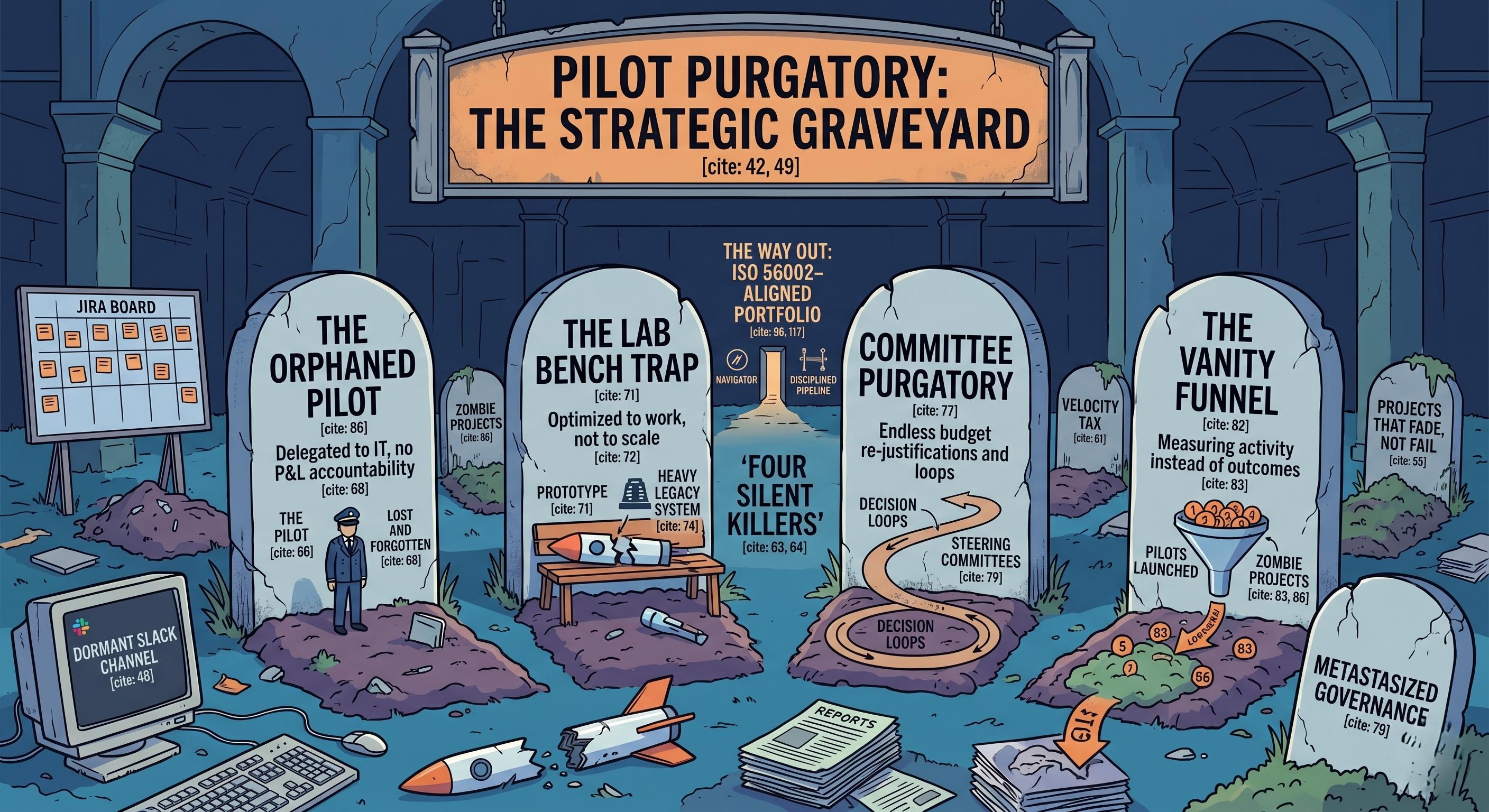
Somewhere in the basement of a global enterprise, a pilot project is quietly celebrating its second birthday. There is no cake. No executive sponsor. No customer waiting on the other side. Just a Jira board with stale tickets, a dormant Slack channel, and a budget line item that nobody has the political will to close formally.
This is Pilot Purgatory. This is the strategic graveyard where most enterprise innovation actually dies. Not in flames, not in bold market rejection, but in the slow, bureaucratic fade between a promising proof-of-concept and a real production-grade product.
The pattern has been documented for nearly a decade. McKinsey’s foundational research on digital pilot projects, originally focused on industrial IoT and digital manufacturing, found that 84% of companies were stuck in pilot mode for more than a year, with fewer than 30% ever reaching wide enterprise adoption. What began as a manufacturing observation has since been adopted by academic researchers as a generalizable framework for stalled innovation across industries. And the most recent evidence is sharper still: MIT’s NANDA initiative reports that 95% of generative AI pilots are failing to deliver measurable P&L impact, despite an estimated $30 to $40 billion in enterprise investment.
The uncomfortable truth? It is rarely the idea that’s broken. It is the operating model around it.
The Reframe: Pilots Don’t Fail. They Fade.
When we talk about "innovation failure," most leaders instinctively picture a dramatic event: a launched product that flops, a press release that ages poorly, a quarterly earnings call where someone has to explain a write-down. Those failures are at least useful because they generate validated learning, the principle Eric Ries built an entire methodology around.
Pilot Purgatory is something far more expensive: failure without a lesson.
Projects don’t get killed; they get forgotten. Sponsors rotate. Priorities shift. The Slack channel goes quiet. Three quarters later, somebody finally archives the workspace, and an eighteen-month investment evaporates without an autopsy. The organization learns nothing. The next pilot, run by a different team, walks straight into the same trap.
This is the real cost of the Innovation Tax: not the failed bets, but the failed systems that prevent failed bets from becoming useful intelligence.
The Four Silent Killers
After two decades of working with Fortune 500 innovation teams, we keep seeing the same four patterns. Together, they account for the overwhelming majority of pilots stuck in limbo.
Killer #1: The Orphaned Pilot
The most common cause of death is also the most preventable. Pilots get delegated to Innovation Labs, Digital Transformation Offices, or IT departments, units with technical capability but no P&L accountability. The moment the executive sponsor changes roles or strategic priorities shift, the pilot loses its air cover. Without a business owner whose bonus is tied to the outcome, no one fights for it. It just drifts.
Killer #2: The Lab Bench Trap
Most proofs-of-concept are optimized to work, not to scale. They run on synthetic data, in sandboxed environments, with a hand-picked group of friendly users. The moment the project meets the real enterprise (legacy ERP integrations, regional compliance variations, security reviews, cross-functional dependencies), the architecture buckles. Teams discover, fourteen months too late, that their elegant prototype was never engineered for the world it was meant to live in.
Killer #3: Committee Purgatory
Traditional Stage-Gate governance was designed for an era when product cycles ran in years, not quarters. In today’s enterprise, that same governance has metastasized into something pathological: endless re-justifications of the same budget, compliance reviews that loop back on themselves, steering committees whose primary output is the next steering committee. By the time a pilot earns its scale-up approval, the market opportunity has already moved on. We call this the Velocity Tax: the compounding cost of decisions that arrive after they matter.
Killer #4: The Vanity Funnel
The most dangerous metric in innovation is "number of pilots launched." It looks brilliant in a board deck. It is also strategically meaningless. When organizations measure activity instead of outcomes, every project becomes immortal. If you only ever define what success looks like, you have no language for declaring failure. The result is a portfolio bloated with zombie projects, each consuming budget, attention, and political capital that should be flowing toward the few bets that actually matter.
The Diagnostic: Audit Your Own Purgatory
Before any framework, run this five-minute audit on your current pilot portfolio:
- Does every active pilot have a single named business owner with P&L accountability, not just a project manager?
- Were kill criteria written before the pilot launched, or only success metrics?
- Is the scale path (integration, compliance, operating model) designed in from day one, or assumed to be "figured out later"?
- Can you state, in one sentence, the strategic question each pilot is designed to answer?
- For pilots older than twelve months: when was the last formal stop / continue / pivot decision made?
If "most don’t" is the honest answer to more than two of these, your innovation pipeline isn’t a portfolio. It is a parking lot.
The Way Out: From Gates to Navigators
Innovation in 2026 isn’t a creativity problem. It’s a logistics problem.
Every serious organization has more ideas than it can resource. The bottleneck has shifted to flow: how fast does an insight travel from a pitch deck to a shipped product? That is the metric that will decide who wins the next decade.
The leaders breaking out of Pilot Purgatory share a common reframe: innovation is a governance problem, not a creative one. They have stopped asking "how do we generate more ideas?" and started asking "how do we move the right ideas through the system faster?"
Three structural shifts are doing the heavy lifting:
- P&L ownership from day one. Every pilot is assigned a business unit owner whose performance review depends on its outcome: scaled, killed cleanly, or pivoted with documented learning. No orphans.
- Pre-defined kill triggers. Borrowed from venture capital practice, these are the specific conditions under which the project will be discontinued, written and signed before kickoff. Killing a project on a pre-agreed trigger is execution, not failure.
- ISO 56002-aligned governance. The international standard for innovation management explicitly frames governance as an enabler of flow, not a brake on it. Adopters report 2-3x faster time-to-decision and significantly less Velocity Tax.
This is the philosophical pivot from gatekeepers to navigators. Governance whose job is no longer to prevent risk, but to accelerate clarity.
The Executive Mandate
Pilot Purgatory is not a creative problem. It is not a talent problem. It is not even, in most cases, a technology problem. It is the predictable consequence of running enterprise innovation on an operating model designed for a slower world.
In 2026, the competitive question is no longer "What are you piloting?" Every serious organization is piloting something. The real question is "How fast can you tell the difference between a winner and a zombie, and act on it?"
The companies that answer that question with conviction will own the second half of the decade. The ones still measuring "pilots launched" will keep filling their basements with quietly aging proofs-of-concept. And then the budget conversation will arrive, and there will be nothing on the dashboard to defend.
Innovation Cloud helps enterprise teams replace Pilot Purgatory with disciplined, ISO 56002-aligned innovation portfolios that include P&L ownership, automated kill gates, and a single source of truth from concept to market.