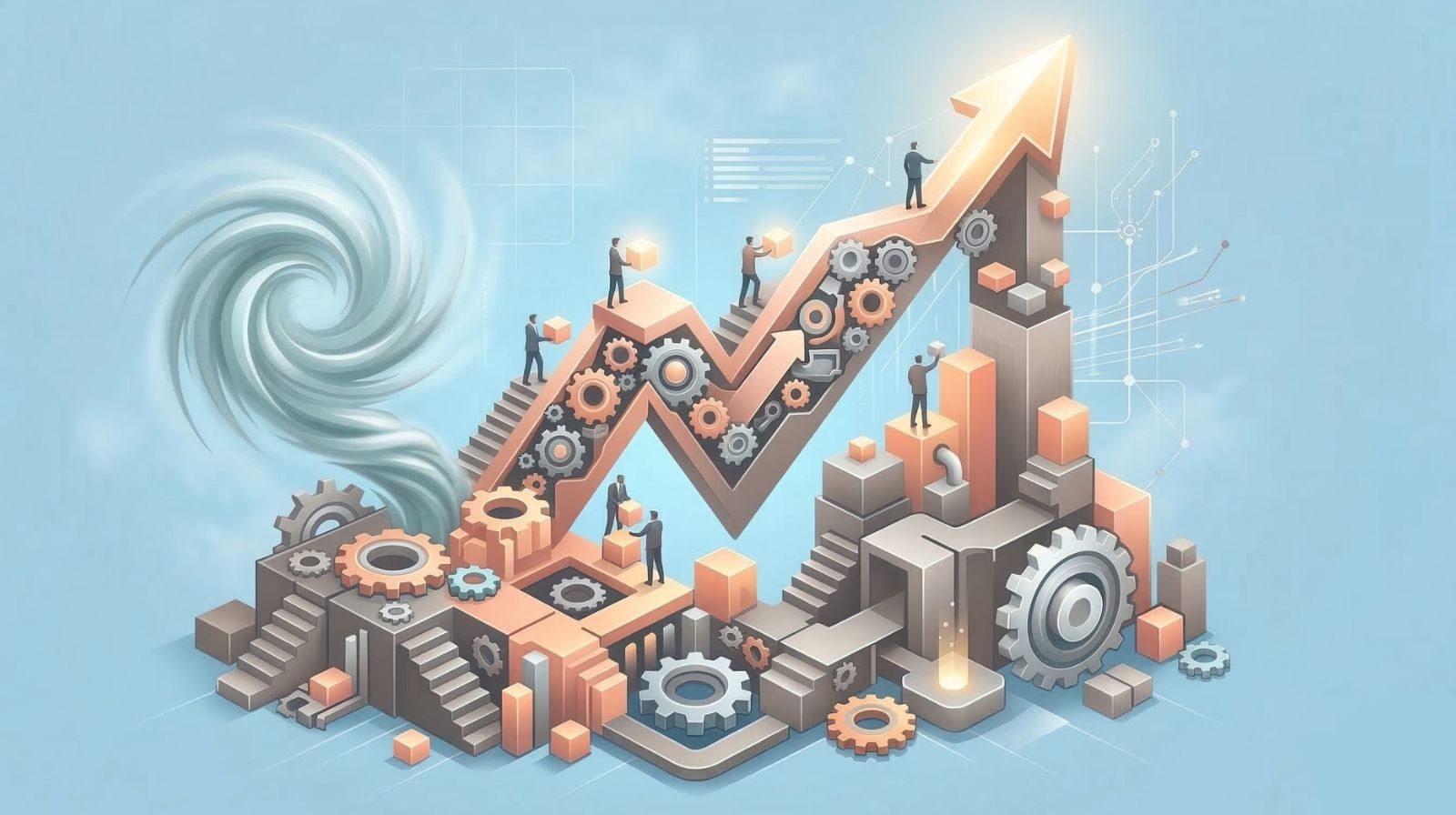
The business world has long been obsessed with the Grand Disruptor- the idea that you must invent something earth-shattering to survive. We have been taught to value the radical pivot and the burn-the-boats mentality. This culture prizes the "Eureka!" moment over the steady endurance of the engine. However, for the modern CEO, the most effective way to grow is no longer the hunt for a miracle. It is the mastery of the subtle, systemic shift.
We are entering the era of The Architecture of Incrementalism. While the market watches for the next headline-grabbing breakthrough, the most resilient leaders are focusing on the compounding power of small, tool-driven optimizations. These are not just efficiency gains. They are the bricks used to build a competitive moat that no rival can jump over.
The Hidden Cost of the Radical Pivot
The disrupt or die narrative has a dark side- organizational whiplash. When a company tries to reinvent itself overnight, it often destroys the very things that made it successful. Radical pivots are expensive, they exhaust your best talent, and they frequently lead to a drop in shareholder value because the friction of the change is greater than the gain of the new idea.
In contrast, the most successful firms today act as Aggressive Incrementalists. They understand that stability is the foundation of change. By focusing on 1% or 2% improvements in their core workflows, they see growth that is sustainable and far less risky. Innovation isn’t a single "skunkworks" project; it is a constant pulse of refinement across the entire company.
Tools as a Strategic Asset
In the past, CEOs viewed software and technology as utilities- something to be managed by the IT department, like electricity or water. Today, that distinction has vanished. Your technical tools are your strategy. To stay ahead, leadership must stop viewing tools as simple expenses and start viewing them as proprietary assets.
The modern enterprise is usually a collection of silos, different departments that don’t talk to each other, each with its own data and its own problems. This creates organizational drag. This is the invisible friction where executives spend half their time chasing information or sitting in meetings just to get everyone on the same page.
By using sophisticated tools, specifically agentic systems that can bridge the gap between these silos, you can remove that drag. When a tool automatically connects your supply chain data to your marketing spend in real-time, you create a margin of profit that a competitor cannot beat with a single disruptive feature.
Hunting for Friction
The most profitable ideas are rarely born in a boardroom. They emerge from friction hunting on the front lines. Your managers and employees know exactly where the business is slow or sticky. The role of the CEO is to provide the infrastructure that allows these small fixes to surface and scale.
With the right tools, a CEO can test subtle changes in pricing, delivery routes, or customer service models in a digital simulation before they ever touch the real-world balance sheet. This allows you to fail fast and small, while succeeding big and permanently.
Furthermore, as basic AI becomes common, the Human-in-the-Loop becomes your ultimate advantage. The goal of technology is not to replace human judgment, but to automate the boring, repetitive tasks. This allows your top talent to focus on high-stakes work: negotiation, ethics, and long-term vision.
Innovation as a Cadence
The winner’s circle is no longer just for those who blew up their business models. It belongs to those who used precision tools to sharpen their existing models to a razor’s edge. These leaders know that a 5% improvement in ten different areas is mathematically better and much safer than a 50% improvement in just one.
Innovation is no longer a department; it is a cadence. It is the sound of a thousand small gears turning in perfect synchronization. It is quiet, it is relentless, and for the savvy leader, it is the most powerful weapon in the arsenal.