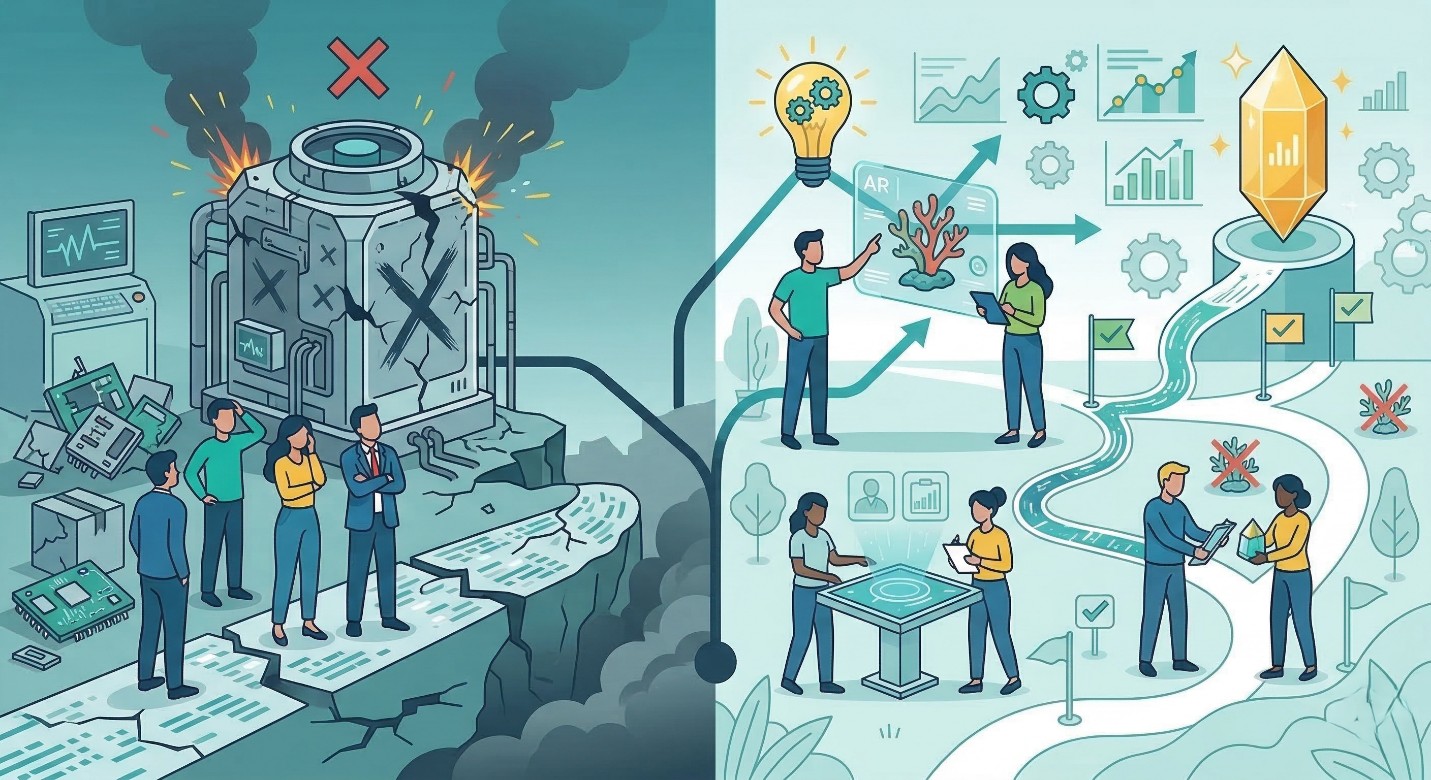
For the last decade, the Minimum Viable Product (MVP) has been the holy grail of Silicon Valley and corporate boardrooms alike. The logic was simple: build a stripped-down version of your idea, get it into the market, and iterate. But in an era where consumer patience is at an all-time low, and Agentic AI can clone your viable product in a weekend, the MVP has become a dangerous trap. It’s how companies end up spending millions building a bridge to nowhere.
Enter the RAT: the Riskiest Assumption Test. The most successful innovators are no longer building products to see if they work; they are building experiments to see why they might fail.
The Problem with Viable
The issue with the MVP model is the word "viable." It encourages teams to focus on building a functional product. You hire developers, design a UI, and set up a supply chain. By the time you realize that nobody actually wants the core service, you’ve already spent your innovation budget and six months of your life.
The RAT flip-flops this. Instead of building a product, you identify the one make-or-break assumption that your entire business model rests on. If that assumption is false, the product is dead. You test that first.
Identifying the Load-Bearing Lie
Every new product is built on a series of assumptions. Usually, we test the easy ones first: "Can we build this?" (Yes, engineers can build almost anything now). "Is the UI pretty?" (Subjective, but manageable).
The load-bearing assumptions are much scarier. For a new AI-driven health diagnostic tool, the assumption isn’t "Can the AI read a scan?" It’s "Will a patient trust a machine more than a doctor?" If the answer to the second question is "no," the technical perfection of the first doesn’t matter.
Innovation leaders at companies like Airbnb and Netflix have shifted their focus to these uncertainty spikes. They don’t build the app; they run a Wizard of Oz test where a human mimics the AI behind the scenes for ten customers. If those ten customers don’t find value, the project will be killed on Tuesday, saving millions that would have been spent by Friday.
The Shift from "Project" to "Protocol"
Traditional product development is treated like a project: it has a start date, an end date, and a launch party. Modern innovation is a protocol. It’s a continuous loop of identifying a risk, designing a 48-hour test, and deciding whether to pivot or persevere.
This approach changes the boardroom conversation. Instead of asking, "When is the launch?" savvy CEOs are asking, "What is the most expensive thing we currently believe to be true, and how do we prove it’s a lie by next week?" This isn’t just about saving money; it’s about cognitive throughput- the ability of an organization to process and discard bad ideas faster than the competition.
Building the Kill Switch Culture
The hardest part of moving from MVP to RAT isn’t the data; it’s the ego. In a traditional corporate structure, killing a project is seen as a failure. In a RAT-driven organization, killing a project is celebrated as a calculated save.
To survive the next wave of disruption, companies must incentivize the Kill Switch. When a team proves their own idea is non-viable within two weeks, they shouldn’t be penalized; they should be handed the next high-priority problem. This creates a culture where the edge isn’t maintained by the number of products launched, but by the speed at which the organization learns what the market doesn’t want.
Velocity of Learning
In 2026, the competitive advantage isn’t your tech stack but your velocity of learning. The companies that will dominate the next decade aren’t those with the biggest R&D budgets, but those that can run the most Riskiest Assumption Tests per quarter.
The goal is no longer to be the company that builds everything. It’s to be the company that is the first to know exactly what not to build.