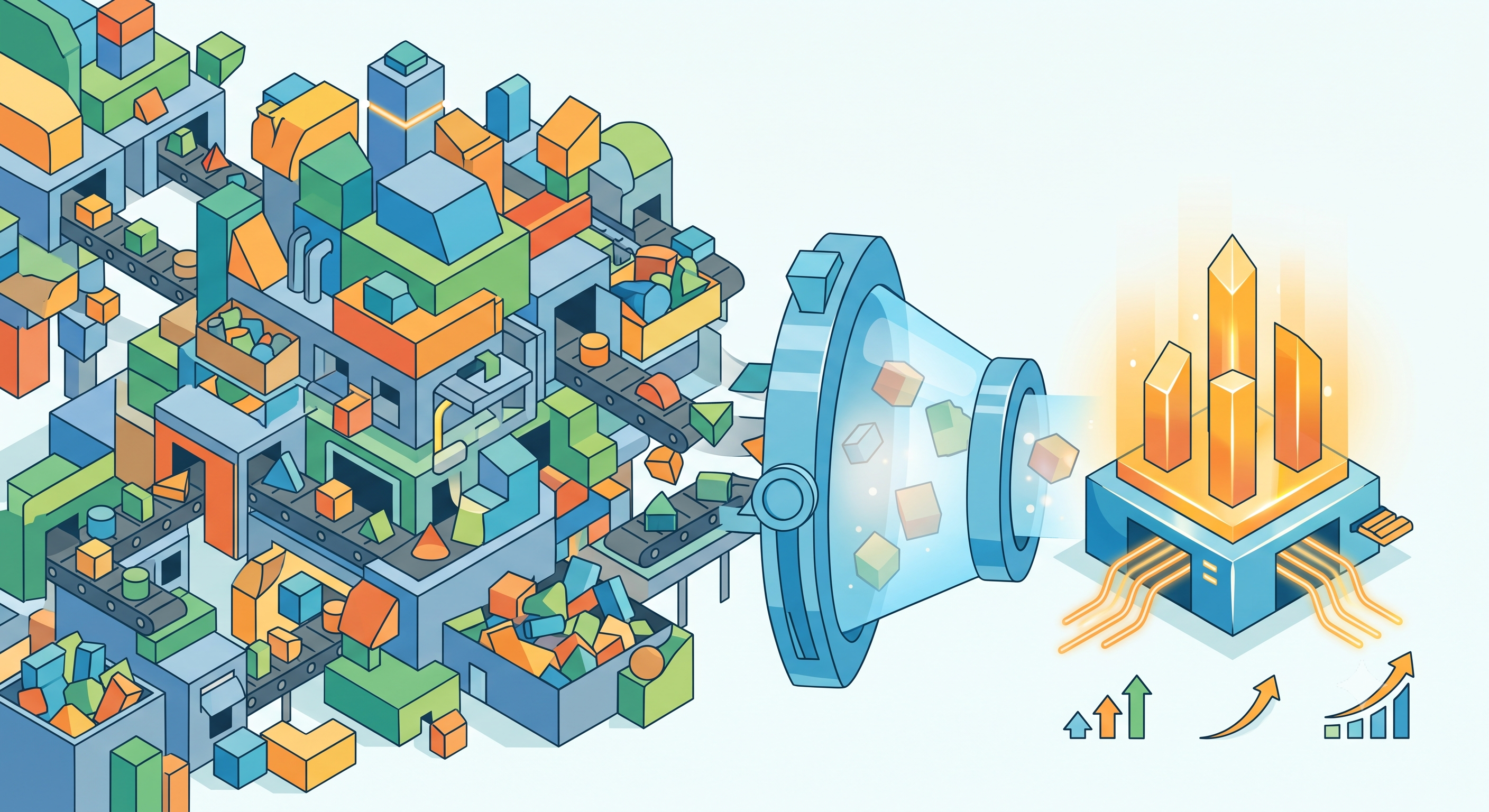
The instinct in innovation is always to add. More products, more variants, more line extensions. The data from the world’s largest consumer companies in 2025 and 2026 says something different.
Unilever demerged its ice cream business, sold Graze, sold its Indonesia Tea Business, and announced the combination of its Foods business with McCormick - all within six months. Nestle reduced product variations by one-fifth, walked away from approximately $750 million in revenue from discontinued SKUs, and is exiting its waters and mainstream vitamins businesses. P&G launched a two-year portfolio and productivity plan in June 2025 that explicitly includes exits of categories, brands, and product forms.
These are not distressed companies making desperate cuts. Unilever returned €6.0 billion to shareholders in 2025. P&G reported its eighth consecutive year of Core EPS growth. Nestle is guiding 3 to 4 percent organic growth with accelerating volume in 2026. They are growing by shrinking - and the logic is worth understanding.
Why the Portfolio Always Gets Too Big
Portfolio sprawl is not a failure of strategy. It is the predictable output of innovation incentive structures. New product launches generate internal wins. Line extensions feel low-risk. And the decision to discontinue something requires a kind of organizational courage that approval processes rarely reward.
The result is a portfolio that is simultaneously too large to manage well and too small in each individual product to justify the attention it consumes. Nestle’s CEO captured it precisely when explaining the SKU rationalization: reducing product variations significantly increased the company’s service levels. The complexity had been imposing a cost that was invisible until it was removed.
The decision to discontinue a product requires organizational courage that approval processes rarely reward. That is how portfolios accumulate complexity no one intended to create.
What Focus Actually Delivers
The Unilever numbers are the clearest evidence. After the Ice Cream demerger, underlying operating margin rose to 20.0%, free cash flow reached €5.9 billion, and Power Brands - the focused core of the remaining portfolio - grew underlying sales by 5.0% with 4.0% volume growth in Q1 2026. The CEO’s summary: "In 2025 we became a simpler, sharper, and faster Unilever." The sequence matters. Simpler first. Sharper second. Faster third.
P&G makes the connection between portfolio focus and innovation speed explicit. The June 2025 plan states that portfolio exits "enable the business to make related interventions in the supply chain - right-sizing and right-locating production to drive efficiencies, faster innovation, cost reduction and more reliable supply." Focus is not just a financial strategy. It is innovation infrastructure.
P&G’s portfolio rationalization plan has a stated goal of faster innovation - not just cost reduction. Focus is the infrastructure that speed requires.
The Process That Makes Subtraction Possible
The companies that do portfolio rationalization well have made it a continuous process, not a crisis response. Four things separate them from the rest.
Discontinuation criteria defined in advance. When a product will be cut is decided by framework, not by judgment. Growth below category average for two consecutive years. Margin contribution below a defined floor. Strategic fit below a threshold. When the criteria exist, the decision is a process output, not a political battle.
Governance with real authority. Review committees that can see the data but cannot act without executive override do not rationalize portfolios. Effective portfolio governance has defined decision rights - the authority to discontinue sits with the portfolio function, not the brand team that championed the product.
Resource redeployment planned alongside discontinuation. Freed resources only create value if they are redeployed deliberately. The best companies identify where formulation capacity, supply chain bandwidth, and marketing budget will go before the cut is made - not after.
Full portfolio visibility, including complexity cost. Industry research estimates that SKU complexity costs CPG manufacturers up to $50 billion in gross profit each year (Procureability, March 2026). Yet a standard gross margin alone is insufficient - significant cost elements linked to supply chain complexity are routinely missing from standard calculations, meaning most companies are making portfolio decisions with an incomplete picture. Traditional margin reports rarely capture the operational impact of SKU complexity; portfolio teams need models that account for manufacturing changeover, supply chain strain, and sales force load to see each SKU’s real cost. Closing that gap is the prerequisite for every other decision.
The Bottom Line
Unilever is simpler, sharper, and faster. Nestle has CHF 1.7 billion in savings and is converging on four categories it can genuinely lead. P&G is investing $1 to 1.6 billion in restructuring specifically to make innovation faster.
The pattern is consistent, the evidence is recent, and the results are measurable. Knowing what not to build is as important as knowing what to build. Both require process. Only one gets the investment it deserves.
Innovation Cloud provides the portfolio management infrastructure that makes subtraction as disciplined as creation - from continuous portfolio visibility and structured discontinuation criteria to governance frameworks with real decision authority.
Schedule a demo: www.innovationcloud.com/page/demo-request.html
Sources
- Unilever, Q4 and Full Year 2025 Results (February 12, 2026)
- Unilever, Q1 2026 Trading Statement (April 30, 2026)
- Nestle, Full-Year Results 2025 and Strategic Update (February 19, 2026)
- Nestle, Half-Year Results 2026 (July 2026)
- Packaging Dive, SKU Rationalization Is In (June 2024)
- P&G, Fueling Growth and Value Creation through Productivity (June 2025)
- P&G, Fourth Quarter and Fiscal Year 2026 Results (July 2026)
- Deloitte, 2026 Consumer Products Industry Outlook (January 2026)
- Procureability, CPG Procurement Strategies to Reduce Complexity (March 2026)